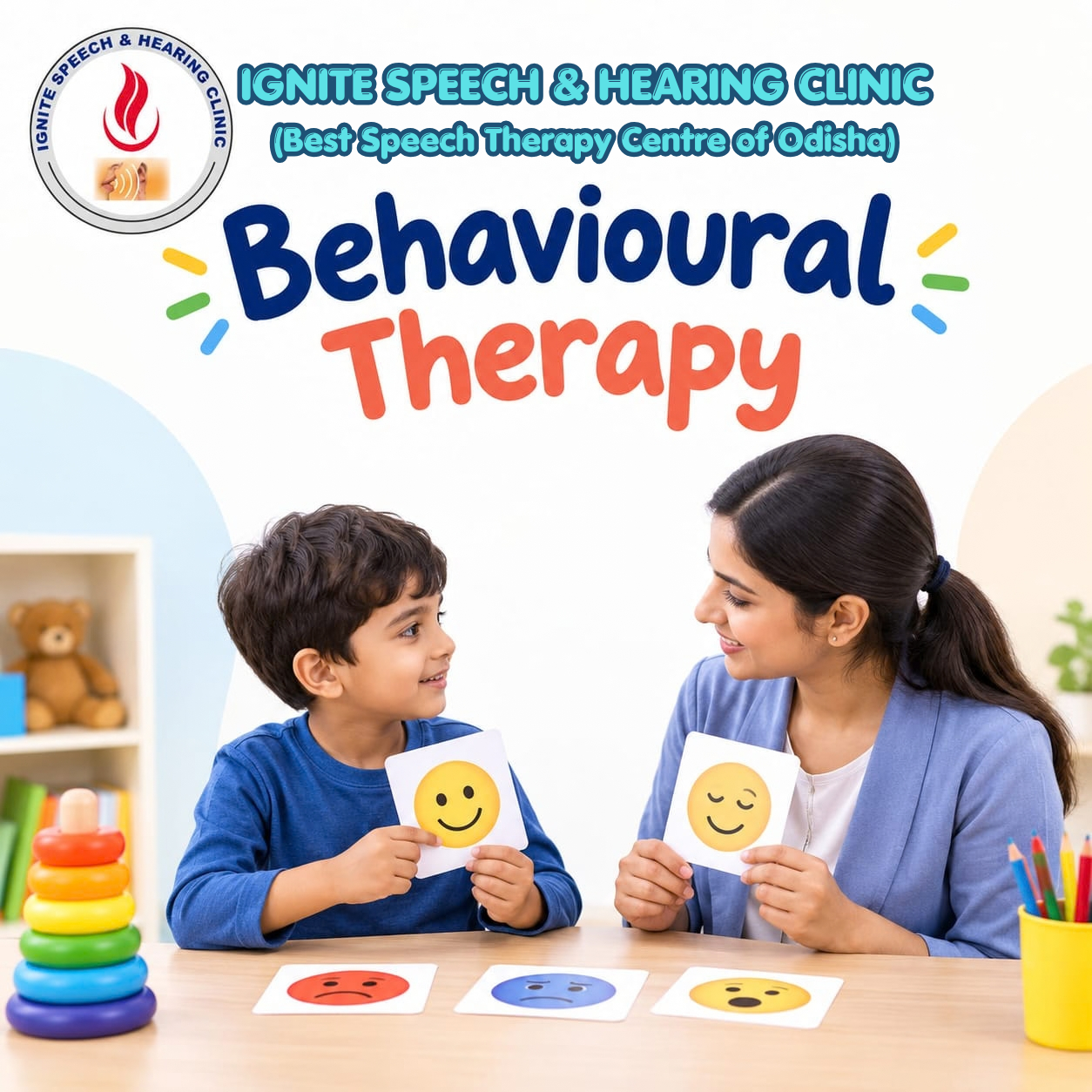
Finding the right Behavioural Therapy Centre in Ravi Talkies, Bhubaneswar can be an important step for parents whose children need support with communication, attention, social interaction, emotional regulation, learning, or everyday routines. Children with Autism Spectrum Disorder (ASD) and Attention-Deficit/Hyperactivity Disorder (ADHD) may experience different developmental challenges, and the right support should be based on each child’s individual strengths, needs, and goals.
IGNITE Speech & Hearing Clinic provides behavioural therapy alongside developmental services such as speech therapy, occupational therapy, special education, autism support, and cognitive therapy. Its multidisciplinary approach can help families explore appropriate support for children’s communication, learning, behaviour, and functional development.
For parents searching for Behavioural Therapy for Children with Autism and ADHD in Ravi Talkies, BBSR, understanding how behavioural intervention works, what skills it may support, and how to select a suitable therapy centre is an important first step.
Every child is different. Some children may need help expressing their needs, participating in group activities, managing transitions, or developing social communication. Others may experience difficulties with attention, impulsivity, following instructions, or completing everyday tasks.
Behavioural therapy can help identify the skills a child needs and create structured opportunities to practise them in a supportive, individualized environment.
What Is Behavioural Therapy for Children?
Behavioural therapy is an approach that helps children develop useful skills, understand expectations, participate in everyday activities, and learn more effective ways to communicate their needs.
It involves understanding the situations in which behaviours occur, identifying possible triggers and unmet needs, and teaching practical skills that support the child’s participation and well-being.
For children, behavioural intervention may focus on:
- Functional communication
- Social interaction and play
- Attention and task participation
- Following instructions
- Emotional regulation
- Managing transitions
- Developing daily living skills
- Learning routines
- Cooperative activities
- Independence at home and school
The approach should be individualized according to the child’s developmental level, communication abilities, interests, and support needs.
Behavioural therapy should not be about punishment, forcing compliance, or suppressing harmless differences. Its purpose should be to support meaningful development, safety, communication, autonomy, and quality of life.
Understanding Autism and ADHD in Children
Autism and ADHD are different neurodevelopmental conditions, although some children may have both.
Understanding their differences can help parents identify the type of support that may be appropriate.
Autism Spectrum Disorder (ASD)
Autism can influence how a child communicates, interacts socially, processes sensory information, experiences routines, and engages with the surrounding world.
Some autistic children may:
- Communicate using words, gestures, pictures, or communication devices
- Prefer predictable routines
- Experience differences in social communication
- Develop strong interests in particular activities
- Respond differently to sounds, textures, lights, or movement
- Need support with transitions or everyday activities
- Prefer particular styles of play or interaction
Every autistic child has an individual profile. Not every child experiences the same challenges or needs the same intervention.
Behavioural therapy may support functional communication, participation, daily living skills, learning, and social interaction when these are meaningful goals for the child.
Attention-Deficit/Hyperactivity Disorder (ADHD)
ADHD is associated with persistent patterns of inattention and/or hyperactivity and impulsivity that can affect everyday functioning.
Some children with ADHD may experience difficulty with:
- Staying focused on activities
- Waiting for a turn
- Following multistep instructions
- Organizing schoolwork
- Completing tasks
- Managing impulses
- Moving between activities
- Remembering routines
- Participating in classroom activities
These behaviours do not automatically mean a child has ADHD. A qualified healthcare professional should evaluate persistent concerns and consider the child’s developmental history and functioning across settings.
Behavioural support may help children develop practical strategies for attention, organization, self-management, routines, and participation.
How Can Behavioural Therapy Help Children with Autism?
Behavioural intervention can support autistic children when it focuses on skills that matter in their everyday lives.
- Developing Functional Communication
Some children may find it difficult to communicate what they want, need, enjoy, or dislike.
A therapist can help identify appropriate ways for the child to express themselves. Depending on the child’s abilities, communication may involve speech, gestures, pictures, signs, or an augmentative and alternative communication (AAC) system.
Possible goals include:
- Requesting help
- Asking for a break
- Making choices
- Expressing discomfort
- Communicating preferences
- Responding during everyday interactions
Speech therapy may complement behavioural intervention when the child also needs support with speech, language, or communication.
- Supporting Social Interaction
Social situations can be confusing or demanding for some autistic children.
Therapy may provide opportunities to practise interactions in ways that respect the child’s communication style and comfort.
Activities might include shared play, turn-taking, requesting a preferred toy, participating in a familiar game, or communicating with another person.
The goal should be meaningful interaction rather than forcing eye contact or expecting every child to behave in the same way.
- Managing Transitions and Routines
Moving from one activity to another can be difficult for children who rely on predictable routines.
Support may include visual schedules, advance warnings, simple explanations, structured choices, and consistent routines.
For example, a visual sequence might show:
Playtime → Clean up → Snack time
The therapist and family can identify which strategies are appropriate for the individual child.
- Building Everyday Independence
Some children benefit from support with daily living activities.
Depending on the child’s needs, intervention may focus on:
- Putting away toys
- Following a familiar routine
- Washing hands
- Dressing
- Asking for assistance
- Participating in mealtimes
- Organizing belongings
Occupational therapy may also be helpful when motor, sensory, or self-care difficulties affect these activities.
- Understanding Distress and Challenging Behaviour
A behaviour may communicate frustration, pain, sensory discomfort, fatigue, confusion, or an unmet need.
Instead of simply trying to stop the behaviour, the therapist should consider what may be causing it and whether the child has a more effective way to communicate or cope.
Intervention may involve identifying triggers, adjusting the environment, teaching functional communication, and supporting emotional regulation.
When behaviour changes suddenly or causes significant distress, medical or other professional assessment may also be necessary.
How Can Behavioural Therapy Help Children with ADHD?
Children with ADHD may benefit from structured support that helps them manage everyday demands and develop practical skills.
- Improving Task Participation
Some children find it difficult to begin or finish activities.
A therapist may break a task into smaller steps, provide clear instructions, use visual reminders, and gradually build the child’s ability to participate.
For example:
- Take out the notebook.
- Complete one question.
- Check the answer.
- Take a planned break if needed.
The strategy should be adapted to the child’s age, learning style, and needs.
- Developing Attention Strategies
Children may find it easier to participate when tasks are clear, manageable, and engaging.
Depending on the child’s needs, useful strategies may include:
- Short, structured activities
- Clear and simple instructions
- Visual task lists
- Planned movement breaks
- Reducing unnecessary distractions
- Positive, specific feedback
- Predictable routines
These strategies are not a replacement for an appropriate ADHD assessment or other recommended care.
- Supporting Impulse Management
Some children may act quickly before considering what happens next.
Therapy can provide opportunities to practise pausing, communicating, waiting, and choosing between options.
Games, role-play, visual reminders, and guided practice may help children develop strategies for everyday situations.
The aim is to teach useful skills rather than shame children for difficulties with self-regulation.
- Improving Organization and Routines
Consistent routines can help children understand what they need to do and when.
A simple morning checklist, for example, might include getting dressed, packing a schoolbag, eating breakfast, and preparing to leave.
Parents and therapists can work together to make routines realistic and achievable.
- Supporting Social Participation
Some children with ADHD may interrupt conversations, struggle with waiting, or find group activities difficult.
Therapy can help them practise listening, turn-taking, recognizing social cues, communicating respectfully, and repairing misunderstandings.
The focus should be on practical skills that help children build positive relationships and participate more comfortably.
Autism and ADHD: Why Individualized Therapy Matters
Autism and ADHD can overlap, but they are not the same condition. Children with either condition may also have different communication, sensory, learning, emotional, or motor needs.
For example, one child may need support with functional communication and transitions, while another may benefit from organization strategies and task planning. A child with both autism and ADHD may require a combination of approaches.
That is why a standardized program may not be suitable for every child.
A personalized plan should consider:
- The child’s strengths and interests
- Communication preferences
- Developmental abilities
- Everyday challenges
- Sensory needs
- Family priorities
- School participation
- Safety and emotional well-being
- Skills the child wants or needs to develop
Therapy goals should be reviewed regularly and adjusted as the child develops.
What Happens During Behavioural Therapy at IGNITE?
At IGNITE Speech & Hearing Clinic, behavioural therapy is listed among the clinic’s developmental services. The clinic also lists autism treatment, speech therapy, occupational therapy, cognitive therapy, and special education.
A typical therapy process may involve the following stages, depending on the service and the child’s needs.
Step 1: Parent Consultation
Parents describe their concerns and explain how the child communicates, learns, plays, and participates in everyday activities.
Information from home and school may help the professional understand the child’s needs.
Step 2: Assessment
The professional considers the child’s strengths, current abilities, and areas where support may be useful.
Assessment should be appropriate to the child’s age, developmental level, and presenting concerns.
Step 3: Setting Meaningful Goals
Goals should be specific, practical, and relevant to the child’s everyday life.
Examples may include asking for help, following a familiar routine, participating in an activity, or learning a strategy for managing transitions.
Step 4: Individualized Intervention
The therapist selects suitable activities and strategies based on the assessment.
Activities may include structured practice, play, visual supports, modelling, communication strategies, and opportunities to practise skills in different situations.
Step 5: Parent Guidance
Parents may receive suggestions for supporting targeted skills at home.
The strategies should be realistic for the family’s routine and appropriate for the child’s needs.
Step 6: Progress Review
Progress should be discussed with the family, and goals should be updated when necessary.
Improvement may look different for each child. Small gains in communication, independence, comfort, or participation can be meaningful.
Parents should confirm the available assessment process, therapist qualifications, and service details directly with the clinic.
Why Early Support Can Be Important
Parents sometimes wait to seek advice because they hope a child will develop particular skills naturally.
Children develop at different rates, but persistent concerns about communication, attention, learning, social interaction, or everyday functioning deserve attention.
An early professional assessment can help families understand:
- Which skills are developing well
- Which areas may need additional support
- Whether further assessment is appropriate
- What intervention options are available
- How home and school can support the child
Early support does not mean every child needs intensive therapy. It means seeking appropriate guidance when concerns arise.
For children with suspected autism or ADHD, behavioural therapy should not replace a comprehensive assessment by an appropriately qualified professional.
How Parents Can Support Children at Home
Parents and caregivers can help children practise useful skills through ordinary daily activities.
Create Predictable Routines
Use simple routines for waking up, meals, school preparation, play, and bedtime.
Visual schedules may be useful for some children.
Give Clear Instructions
Use short, specific instructions and allow the child enough time to process them.
When necessary, break complex tasks into smaller steps.
Encourage Functional Communication
Help children communicate their needs in ways that work for them, whether through speech, gestures, pictures, or communication devices.
Use Positive and Specific Feedback
Recognize useful efforts and progress. For example, say, “You asked for help clearly,” rather than offering only general praise.
Offer Appropriate Choices
Choices such as selecting between two activities can help children participate and communicate their preferences.
Allow Movement and Breaks
Some children benefit from movement opportunities and planned breaks during demanding activities.
Coordinate With Professionals
Follow strategies agreed upon with the child’s therapist and share observations about what works at home or school.
Avoid using punishment, humiliation, or the removal of essential communication tools as a way to force compliance.
Behavioural Therapy and Other Developmental Services
Some children may benefit from support from more than one professional.
Behavioural Therapy
May focus on functional behaviour, learning strategies, participation, routines, and skills for everyday life.
Speech Therapy
May support speech, language, communication, and related areas according to the child’s needs.
Occupational Therapy
May address functional participation, motor skills, sensory needs, self-care, and daily activities.
Special Education
May support individualized learning goals and participation in educational activities.
The services that are appropriate depend on the child’s assessment. Not every child needs every service, and multidisciplinary care works best when goals are coordinated around the child’s needs.
Choosing a Behavioural Therapy Centre Near Ravi Talkies, BBSR
For families searching for the Best Behavioural Therapy Centre in Ravi Talkies, convenience matters, but it should not be the only consideration.
Before choosing a centre, parents can ask:
- Are the professionals appropriately qualified?
Ask about the therapist’s training, professional qualifications, and experience working with children with similar needs.
- Is the therapy individualized?
The plan should reflect the child’s strengths, challenges, interests, and family priorities.
- Are parents involved?
Families should receive clear explanations of goals and appropriate guidance for home practice.
- Are the goals meaningful?
Intervention should support communication, safety, independence, learning, comfort, and everyday participation.
- Is progress reviewed?
Parents should know which skills are being targeted and how progress will be evaluated.
- Is the child treated with respect?
Children should feel safe and supported. Therapy should respect their communication, sensory needs, dignity, and autonomy.
Behavioural Therapy in Ravi Talkies for Children With Autism and ADHD
Families living around Ravi Talkies, Old Town, Kalpana Square, BJB Nagar, Lewis Road, Rajmahal Square, and nearby areas of Bhubaneswar may search for local developmental services that are accessible for regular appointments.
When considering Behavioural Therapy in Ravi Talkies, BBSR, parents should look for a service that provides an appropriate assessment, explains its intervention approach, and considers the child’s needs in everyday settings.
IGNITE Speech & Hearing Clinic lists behavioural therapy and autism-related support among its services. Its website also describes multidisciplinary services, including speech therapy, occupational therapy, and special education.
Parents should confirm the current branch address, appointment availability, and the services offered at the relevant branch before visiting.
Frequently Asked Questions
- Can behavioural therapy help children with autism?
Behavioural therapy may support autistic children with meaningful goals such as functional communication, daily living skills, learning, transitions, and social participation. The approach should be individualized and respect the child’s comfort, autonomy, and communication preferences.
- Can behavioural therapy help children with ADHD?
It may help children develop practical strategies for task participation, routines, organization, impulse management, and social interaction. The most appropriate support depends on the child’s needs and professional assessment.
- Can a child have both autism and ADHD?
Yes. Autism and ADHD can occur together. A qualified professional can assess the child’s developmental history and current needs to guide appropriate support.
- At what age can behavioural therapy begin?
Support may be considered at different ages when developmental or functional concerns arise. The appropriate approach depends on the child’s age, needs, abilities, and assessment findings.
- How long does behavioural therapy take to show progress?
There is no single timeframe. Progress depends on the child’s goals, needs, intervention approach, opportunities to practise skills, and other factors. Goals should be reviewed regularly with the family.
- Does behavioural therapy replace medication for ADHD?
No. Behavioural support and medication are different treatment options. Some children may benefit from a combination of approaches, depending on a qualified healthcare professional’s assessment and recommendations. Parents should discuss treatment decisions with the child’s clinician.
- Does IGNITE Speech & Hearing Clinic provide behavioural therapy?
IGNITE lists behavioural therapy among its services, alongside autism treatment, speech therapy, occupational therapy, cognitive therapy, and special education. Contact the clinic to confirm which services are available at the Ravi Talkies branch.
- How can parents contact IGNITE Speech & Hearing Clinic?
The clinic website lists the contact number 9337055243 and Visit www.gloignitehealthcare.com or contact the clinic to confirm the branch address and book an appointment.
Conclusion
Children with autism and ADHD may experience different challenges with communication, attention, social interaction, emotional regulation, learning, and everyday routines. With appropriate support, they can work towards developing skills that improve their participation, independence, comfort, and quality of life.
Behavioural Therapy for Children with Autism and ADHD in Ravi Talkies, BBSR should begin with understanding the individual child rather than applying the same expectations or strategies to everyone.
IGNITE Speech & Hearing Clinic provides behavioural therapy alongside other developmental services, including speech therapy, occupational therapy, autism support, and special education. Families can contact the clinic to discuss their child’s needs and confirm the availability of relevant services at the Ravi Talkies branch.
Every child deserves to be understood, respected, and supported. With individualized goals, family involvement, and appropriate professional guidance, children can continue building skills that help them participate more confidently in everyday life.
