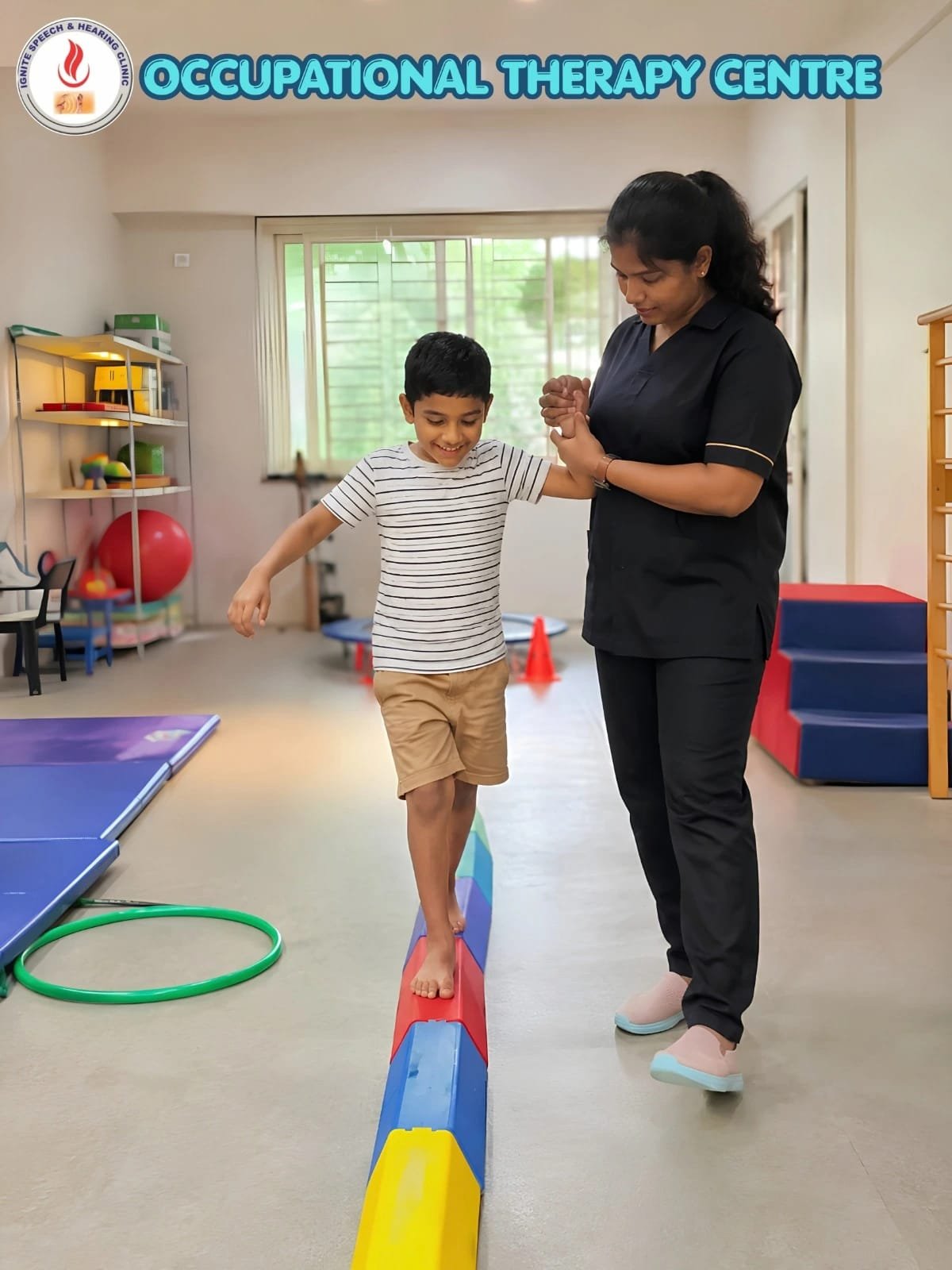
Best Occupational Therapy Centre in Baramunda, Bhubaneswar | IGNITE
Children learn, play, communicate, and become independent at different rates. Some children may find certain everyday activities easy, while others may need additional support with handwriting, pencil control, coordination, sensory experiences, attention, dressing, feeding, play, or classroom participation.
For parents looking for an Occupational Therapy Centre in Baramunda, Bhubaneswar, understanding what occupational therapy involves can help them make an informed decision about professional support.
IGNITE Speech & Hearing Clinic provides occupational therapy as part of a broader multidisciplinary range of services for children and adults. The clinic offers occupational therapy, Speech Therapy, Behavioural Therapy, Special Education, Cognitive Therapy, Physiotherapy, Hearing Assessment, and other services.
The focus of pediatric occupational therapy is not simply on completing exercises. It is about helping a child participate more effectively in meaningful everyday activities at home, school, and in the community.
What Is Occupational Therapy?
Occupational therapy is a healthcare profession that supports people in performing activities that are meaningful and necessary in everyday life.
For children, these activities can include:
- Playing with toys and peers
- Holding and using a pencil
- Drawing and writing
- Using scissors
- Eating independently
- Dressing and undressing
- Brushing teeth
- Following daily routines
- Participating in classroom activities
- Using both hands together
- Maintaining attention during tasks
- Developing age-appropriate independence
Children may experience difficulties in one or several of these areas for different reasons. An occupational therapist can assess the child’s functional abilities and identify areas where support may be appropriate.
At IGNITE, the occupational therapy service describes a focus on sensory and motor skill development alongside broader developmental goals. The clinic also describes play-based activities for skills such as hand-eye coordination, balance, and fine motor development.
Occupational Therapy in Baramunda
Pediatric occupational therapy in Baramunda can support children who experience difficulties with everyday functional activities.
A child may have good understanding but struggle to write. Another child may have strong language skills but find dressing, feeding, or coordination difficult. Some children may find particular sounds, textures, movements, or environments uncomfortable.
These differences can affect participation at home and school.
Occupational therapy looks at the relationship between the child, the activity, and the environment. Therapy goals are therefore generally based on what the child needs to do in real life.
For example:
Difficulty with handwriting → work on fine motor and visual-motor skills.
Difficulty getting dressed → practise functional dressing steps.
Difficulty participating in classroom activities → work on relevant attention, motor, organization, and participation skills.
Difficulty with sensory experiences → assess the child’s sensory responses and develop appropriate strategies.
The exact approach should always be individualized following professional assessment.
When Might a Child Need Occupational Therapy?
Not every developmental difference requires therapy. Children develop at different rates, and occasional difficulty with an activity is not necessarily a reason for intervention.
However, parents may consider discussing an assessment with a qualified professional when difficulties are persistent or interfere with everyday participation.
Some signs may include:
- Difficulty holding a pencil correctly
- Difficulty drawing or colouring
- Trouble using scissors
- Difficulty using both hands together
- Poor hand-eye coordination
- Difficulty with age-appropriate dressing
- Difficulty using a spoon or other utensils
- Challenges with personal-care routines
- Difficulty sitting and participating in activities
- Difficulty coordinating movements
- Trouble completing school tasks
- Difficulty managing certain sensory experiences
- Challenges with play or everyday independence
These signs do not automatically indicate a diagnosis or mean that occupational therapy is required. An appropriate assessment is important to understand the child’s individual strengths and needs.
Skills Occupational Therapy May Support
Occupational therapy can address several functional areas depending on the child’s assessment and goals.
- Fine Motor Skills
Fine motor skills involve controlled movements of the hands and fingers.
Children use fine motor skills for:
- Writing
- Drawing
- Colouring
- Buttoning clothes
- Opening containers
- Picking up small objects
- Using scissors
- Building with blocks
- Manipulating toys
Activities can be selected according to the child’s age, abilities, and specific functional goals.
- Hand-Eye Coordination
Hand-eye coordination allows children to coordinate what they see with the movements of their hands.
It can be important for:
- Writing
- Drawing
- Catching and throwing
- Using utensils
- Completing puzzles
- Building activities
- Manipulating classroom materials
IGNITE’s occupational therapy information specifically describes activities targeting hand-eye coordination and fine motor skills.
- Gross Motor Coordination
Gross motor skills involve larger body movements. Depending on individual needs, occupational therapy activities may address areas such as:
- Balance
- Postural control
- Body coordination
- Bilateral coordination
- Movement planning
- Functional participation
The therapist determines which areas are relevant after assessment.
- Sensory Processing
Children receive sensory information through systems involving touch, movement, vision, hearing, taste, and other sensory inputs.
Some children may react strongly to certain sensory experiences, while others may seek additional movement or sensory input.
Occupational therapy may incorporate appropriate sensory-based strategies when they are relevant to the child’s functional needs. IGNITE’s occupational therapy service also discusses sensory integration strategies in relation to children’s participation and regulation.
- Self-Care Skills
Independence in daily activities is an important part of childhood development.Occupational therapy may support age-appropriate skills such as:
- Eating
- Dressing
- Grooming
- Washing hands
- Brushing teeth
- Toileting routines
- Organising personal belongings
The objective is not to rush independence but to help children gradually participate in activities according to their abilities.
Occupational Therapy for Children with Developmental Challenges
Occupational therapy may form part of a multidisciplinary support plan for children with different developmental or functional needs.
Autism
Some autistic children may experience differences in sensory processing, motor coordination, self-care, play, or participation in daily routines.
Occupational therapy can focus on functional goals that are meaningful to the individual child.
IGNITE states that its multidisciplinary team can include speech therapists, occupational therapists, and behavioural specialists for children receiving developmental support.
ADHD
Children with ADHD may experience difficulties affecting task participation, organization, activity regulation, attention, or everyday routines.
Occupational therapy may address functional strategies when these difficulties interfere with daily activities.
Developmental Delay
Children with developmental delays may require additional support in areas such as motor skills, self-care, coordination, play, or functional independence.
A professional assessment can help identify specific areas requiring attention.
Learning and School Participation Difficulties
Some children experience difficulties with handwriting, visual-motor coordination, classroom organization, or completing practical school tasks.
Occupational therapy may address relevant underlying functional skills where appropriate.
Occupational Therapy and Speech Therapy: What Is the Difference?
Occupational therapy and speech therapy are different professional disciplines, but they can complement each other.
Speech therapy primarily focuses on areas such as speech, language, communication, voice, fluency, and related concerns within the professional’s scope.
Occupational therapy focuses on functional participation, including areas such as motor skills, sensory processing, self-care, play, school activities, and independence.
Some children may benefit from one service, while others may require support from multiple professionals.
Because IGNITE provides both Speech Therapy and Occupational Therapy, families can discuss their child’s different developmental concerns with the relevant professionals.
How Occupational Therapy at IGNITE Can Be Individualized
Every child has different abilities, challenges, interests, and goals. Therefore, a therapy plan should not be identical for every child.
A typical process may include:
Step 1: Understanding the Parent’s Concerns
Parents can describe what they have noticed at home, school, or during everyday activities.
Step 2: Professional Assessment
The therapist evaluates relevant functional abilities and identifies areas that may require support.
Step 3: Setting Meaningful Goals
Goals can be connected to everyday activities.
For example:
- Improving pencil control for classroom writing
- Increasing independence during dressing
- Improving coordination during play
- Supporting participation in structured activities
Step 4: Individualized Activities
Therapy activities are selected according to the child’s developmental level and functional goals.
Step 5: Parent Guidance
Parents can receive suggestions for supporting appropriate skills at home.
Step 6: Reviewing Progress
Progress can be monitored over time, and goals may be adjusted according to the child’s development and changing needs.
IGNITE’s website states that parents receive home activities and guidance and that progress is reviewed periodically.
Why Parents in Baramunda May Consider a Multidisciplinary Clinic
Developmental concerns do not always occur in isolation.
For example, a child may experience difficulties with communication as well as fine motor skills. Another child may need support with speech, behaviour, classroom participation, and self-care.
IGNITE lists multiple services including:
- Occupational Therapy
- Speech Therapy
- Behavioural Therapy
- Special Education
- Cognitive Therapy
- Physiotherapy
- Autism Treatment
- Hearing Assessment
- Hearing Aid Services
- Early Intervention
The availability of multiple services does not mean every child needs all of them. The appropriate services should depend on individual assessment and professional recommendations.
How Parents Can Support Occupational Therapy at Home
Parents can support everyday development by incorporating appropriate activities into normal routines.
Encourage Age-Appropriate Independence
Give your child opportunities to try simple tasks independently before providing assistance.
Use Everyday Activities
Activities such as drawing, building blocks, puzzles, opening containers, dressing, and helping with simple household routines can provide opportunities to practise functional skills.
Follow Professional Recommendations
If the therapist provides specific home activities, follow those recommendations rather than introducing exercises that may not be appropriate for your child.
Keep Practice Positive
Children often respond better when activities are engaging and connected to their interests.
Celebrate Small Progress
Progress can happen gradually.
Holding a pencil for longer, completing part of a dressing routine, using a spoon independently, or participating in a classroom activity can all represent meaningful steps.
Choosing an Occupational Therapy Centre in Baramunda, Bhubaneswar
When searching for an Occupational Therapy Centre in Baramunda, parents should consider more than online rankings or promotional claims.
Useful questions include:
Is the child’s assessment individualized?
The therapist should understand the child’s specific strengths and difficulties.
Are therapy goals practical?
Goals should relate to meaningful activities at home, school, play, or daily life.
Are parents involved?
Parent guidance can help maintain consistency between therapy sessions and home routines.
Is progress monitored?
Parents should understand what skills are being addressed and how progress is being reviewed.
Is the environment appropriate for children?
A comfortable and supportive environment can encourage participation.
Can different professionals coordinate when necessary?
For children with multiple developmental needs, access to complementary services may be useful.
Why Consider IGNITE Speech & Hearing Clinic in Baramunda?
IGNITE Speech & Hearing Clinic has a Baramunda branch in Bhubaneswar and lists Occupational Therapy among its services.
The clinic describes its occupational therapy service as supporting sensory and motor skill development alongside broader communication and developmental goals. Its website also describes personalized treatment plans and a multidisciplinary team approach.
The Baramunda branch is listed at:
IGNITE Speech & Hearing Clinic
B-106, BDA Colony, Baramunda, Bhubaneswar, Odisha
The official website currently lists this Baramunda location.
For parents considering occupational therapy, the appropriate first step is to discuss the child’s concerns with a qualified professional and determine whether an assessment or therapy is suitable.
Frequently Asked Questions
What does a pediatric occupational therapist do?
A pediatric occupational therapist supports children with functional activities such as fine motor skills, coordination, self-care, play, school participation, sensory-related needs, and independence. The specific intervention depends on the child’s assessment and goals.
Is occupational therapy only for children with autism?
No. Occupational therapy may be relevant for children with various functional, developmental, motor, sensory, learning, or participation difficulties. Whether therapy is appropriate should be determined through professional assessment.
Can occupational therapy help with handwriting?
Occupational therapy may support handwriting-related skills such as fine motor control, hand-eye coordination, visual-motor integration, posture, and pencil control when these are contributing to the difficulty.
Can occupational therapy help with sensory difficulties?
Occupational therapists can assess sensory-related difficulties and, where appropriate, incorporate individualized sensory strategies into a broader functional therapy plan.
How do I know if my child needs occupational therapy?
If your child consistently struggles with everyday activities such as writing, dressing, feeding, coordination, play, classroom participation, or age-appropriate independence, you can discuss your concerns with a qualified professional.
Does IGNITE provide Occupational Therapy in Baramunda?
Yes. IGNITE Speech & Hearing Clinic lists Occupational Therapy among its services and has a branch in Baramunda, Bhubaneswar.
Where is IGNITE Speech & Hearing Clinic in Baramunda?
The current IGNITE website lists the Baramunda branch at B-106, BDA Colony, Baramunda, Bhubaneswar, Odisha.
Do parents receive home guidance?
IGNITE states that parents can receive home activities and guidance to reinforce appropriate therapy goals outside the clinic.
Conclusion
Finding the right Occupational Therapy Centre in Baramunda, Bhubaneswar starts with understanding the child’s individual needs rather than choosing a service based only on promotional claims.
Occupational therapy can support meaningful areas of childhood development, including fine motor skills, coordination, sensory processing, self-care, play, classroom participation, and functional independence.
At IGNITE Speech & Hearing Clinic, Occupational Therapy is offered alongside Speech Therapy, Behavioural Therapy, Special Education, Cognitive Therapy, Physiotherapy, Autism Treatment, and hearing services. This multidisciplinary model can provide families with access to different developmental services according to their individual needs.
If you are concerned about your child’s development or everyday participation, an appropriate professional assessment can help you understand the child’s strengths, challenges, and possible support options.
IGNITE Speech & Hearing Clinic – Baramunda
📍 B-106, BDA Colony, Baramunda, Bhubaneswar, Odisha
