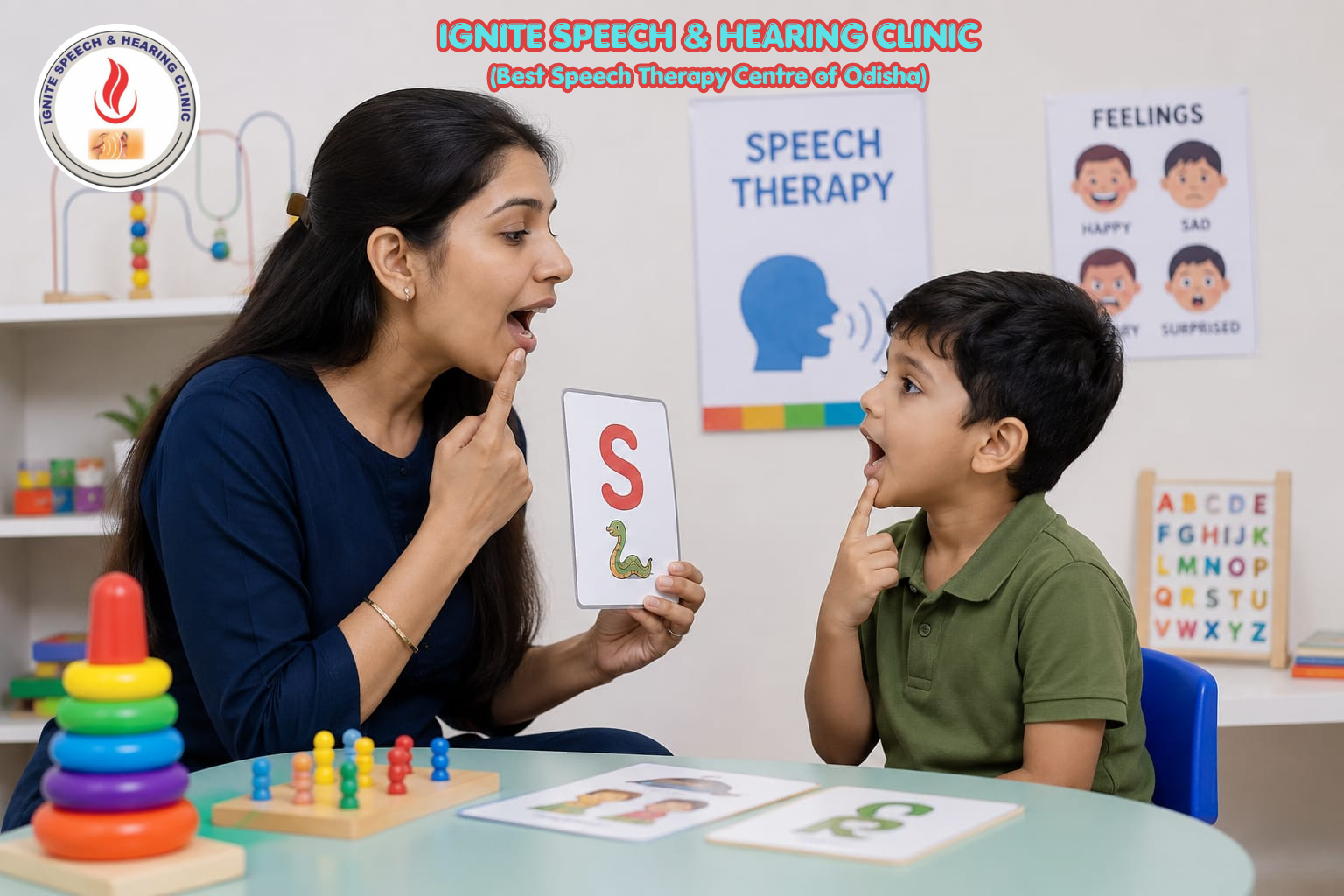
Best Speech Therapy Centre in Cuttack |IGNITE
Finding the Best Speech Therapy Centre in Cuttack for children can be an important step when a child is experiencing difficulties with speech, language, communication, pronunciation, fluency, voice, or social communication. Speech therapy is not simply about helping a child pronounce words correctly. Pediatric speech therapy focuses on helping children communicate more effectively and participate confidently in everyday situations at home, school, and in social environments.
For parents in Cuttack and nearby areas such as CDA, Link Road, Badambadi, College Square, Ranihat, Tulsipur, Mangalabag, and surrounding locations, choosing an accessible and child-focused speech therapy centre can make regular sessions more convenient.
IGNITE Speech & Hearing Clinic provides speech therapy services for children and lists speech-language support among its services. A child-focused approach can help therapists understand each child’s communication needs and develop therapy goals according to their individual abilities.
But what exactly does pediatric speech therapy involve? Which children may benefit from speech therapy? What should parents consider when choosing a speech therapy centre in Cuttack? And how can parents support communication development at home?
This guide explains these questions in detail.
What Is Speech Therapy?
Speech therapy is a specialised area of speech-language therapy that supports children who experience difficulties with communication.
Communication includes much more than speaking.
Children may need support with:
- Understanding language
- Using words and sentences
- Pronouncing sounds
- Expressing needs and ideas
- Following instructions
- Answering questions
- Conversational skills
- Social communication
- Fluency
- Voice
- Feeding or oral-motor-related communication concerns when clinically appropriate
A speech-language professional evaluates the child’s communication abilities and develops goals based on the child’s individual needs.
For example, one child may understand everything but have difficulty expressing themselves.
Another child may speak frequently but have difficulty forming clear speech sounds.
Another may have difficulty understanding instructions.
Another may struggle with social communication.
Therefore, speech therapy should not follow a single approach for every child.
Why Are Parents Searching for Speech Therapy in Cuttack?
Cuttack is an important educational and residential city in Odisha, with families living across areas such as CDA, Badambadi, Link Road, Ranihat, College Square, Mangalabag, and nearby communities.
For parents, accessibility can be an important consideration because speech therapy may involve regular sessions over a period of time.
A nearby Speech Therapy Centre in Cuttack can make it easier for families to maintain consistent appointments.
However, location should not be the only consideration.
When selecting a pediatric speech therapy centre, parents should consider:
- The qualifications and experience of the speech-language professional
- Whether the child receives an appropriate communication assessment
- Whether therapy goals are individualized
- Whether parents receive home guidance
- Whether progress is monitored
- Whether the centre works with other professionals when necessary
- Whether the environment is comfortable for children
- Whether therapy focuses on functional communication
These factors can be more important than simply choosing the closest centre.
How Speech Therapy Supports Child Development
Communication plays an important role in a child’s overall development.
Children use communication to:
- Express needs
- Ask questions
- Share feelings
- Learn at school
- Interact with family
- Play with other children
- Follow instructions
- Develop relationships
- Participate in daily activities
When communication is difficult, children may become frustrated or avoid certain situations.
Pediatric speech therapy can support different areas of communication depending on the child’s needs.
- Speech Sound and Pronunciation
Some children have difficulty producing certain speech sounds clearly.
Parents may notice that a child:
- Mispronounces certain sounds
- Is difficult for others to understand
- Leaves sounds out of words
- Replaces one sound with another
- Has difficulty saying longer words
- Continues using younger-sounding speech patterns
A speech-language professional can assess the child’s speech sound development and determine whether intervention may be appropriate.
Therapy may use age-appropriate activities to develop accurate sound production and improve overall intelligibility.
The goal is not simply to make a child repeat sounds.
The therapist works toward helping the child use the sounds accurately in meaningful words, sentences, and everyday conversations.
- Speech Delay
Speech delay is one of the common reasons parents seek professional guidance.
A child may have difficulty:
- Saying their first words
- Learning new words
- Combining words
- Using sentences
- Naming familiar objects
- Communicating wants and needs
- Talking about experiences
Children develop at different rates, but persistent communication concerns should be discussed with an appropriately qualified professional.
A speech-language assessment can help parents understand the child’s current communication skills and whether intervention may be beneficial.
Early support can provide opportunities for children to develop functional communication skills.
- Language Development
Language includes understanding and using words, sentences, concepts, and communication rules.
Some children may have difficulty with receptive language, which involves understanding communication.
They may struggle to:
- Follow instructions
- Understand questions
- Identify objects
- Understand concepts
- Follow stories
- Understand conversations
Other children may have difficulty with expressive language.
They may struggle to:
- Find the right words
- Form sentences
- Explain ideas
- Describe events
- Answer questions
- Tell stories
Speech therapy can target the specific language skills that are affecting the child’s daily participation.
- Communication for Children with Autism
Autistic children can have very different communication profiles.
Some children may speak fluently but experience difficulties with social communication.
Others may use a small number of words or have limited spoken communication.
Some children may use gestures, pictures, communication systems, or other forms of augmentative and alternative communication.
Speech therapy can focus on functional communication based on the child’s individual strengths and needs.
Goals may include:
- Expressing wants and needs
- Understanding communication
- Expanding functional vocabulary
- Developing conversational skills
- Improving social interaction
- Taking turns during communication
- Understanding and responding to questions
- Supporting alternative communication when appropriate
The goal should be meaningful communication and participation rather than simply increasing the number of spoken words.
- Stammering and Fluency Difficulties
Some children experience interruptions in the flow of speech.
These may include:
- Repeating sounds
- Repeating words
- Stretching sounds
- Getting stuck while speaking
- Pausing unexpectedly
Occasional repetitions can occur during normal speech development, but persistent or concerning fluency difficulties may benefit from professional evaluation.
A speech-language professional can assess the child’s fluency and provide appropriate guidance.
Therapy may focus on communication confidence, reducing communication-related anxiety, supporting comfortable speaking, and developing individualized fluency strategies where appropriate.
Parents should avoid telling a child to “speak faster” or “stop stammering,” as negative reactions can sometimes increase communication pressure.
- Social Communication Skills
Communication is not only about saying words.
Children also need to learn how to use communication socially.
Social communication can include:
- Taking turns
- Starting conversations
- Maintaining a topic
- Responding appropriately
- Understanding facial expressions
- Understanding conversational cues
- Asking for help
- Participating in group activities
Some children may speak well but still struggle with these skills.
Speech therapy can use play-based and structured activities to support functional social communication.
- Voice Therapy for Children
Voice difficulties can sometimes affect children.
A child may have:
- A consistently unusual voice quality
- Excessive hoarseness
- Vocal strain
- Difficulty maintaining comfortable voice use
Persistent voice concerns should be assessed by appropriate medical and speech-language professionals because voice problems can have different causes.
Therapy, when recommended, may focus on healthy voice use and communication strategies.
Speech Therapy for Children with Developmental Delays
Developmental delays can affect communication in different ways.
A child may experience difficulties with:
- Speech
- Understanding language
- Expressive language
- Social communication
- Play communication
- Following instructions
- Functional communication
Speech therapy can be part of an early intervention or multidisciplinary support program.
The therapy plan should depend on the child’s assessment.
For example, one child may need support with vocabulary and sentence development, while another may require support with functional communication and social interaction.
Speech Therapy for Children with ADHD
Children with ADHD may experience challenges that affect communication and classroom participation.
These can include:
- Difficulty listening
- Interrupting conversations
- Difficulty following multi-step instructions
- Trouble organizing thoughts
- Difficulty maintaining a conversation
- Challenges with classroom communication
Speech-language support may address functional communication and language skills when these are affecting daily participation.
Speech therapy is not a universal treatment for ADHD, but it can be useful when a child has co-occurring communication or language difficulties.
Oral-Motor and Feeding-Related Support
Some pediatric speech-language professionals also work with feeding and oral-motor concerns when these fall within their professional scope and training.
Children may experience:
- Difficulty chewing
- Difficulty managing certain food textures
- Problems using oral movements efficiently
- Feeding-related communication concerns
- Difficulty progressing with age-appropriate feeding skills
Feeding difficulties should be assessed carefully because they can have different causes.
If a child has problems with swallowing, nutrition, growth, or medical concerns, appropriate medical and feeding professionals may also need to be involved.
How Does a Speech Therapy Assessment Work?
Before developing a therapy program, a speech-language professional should understand the child’s communication strengths and difficulties.
An assessment may consider:
Speech Sounds
How clearly the child produces speech sounds.
Receptive Language
How well the child understands spoken language.
Expressive Language
How effectively the child communicates using words and sentences.
Fluency
How smoothly the child speaks.
Voice
Quality, pitch, loudness, and other voice characteristics when relevant.
Social Communication
How the child uses communication during interactions.
Functional Communication
How effectively the child communicates needs, ideas, feelings, and information in everyday situations.
The assessment may involve caregiver discussions, observation, structured tasks, and standardized assessment tools when appropriate.
The results help the professional identify areas that may benefit from intervention.
Why Individualized Speech Therapy Matters
There is no single speech therapy exercise that is suitable for every child.
Consider two children.
Child A understands language well but has difficulty producing certain speech sounds.
Child B can pronounce words clearly but has difficulty understanding instructions and forming sentences.
Their therapy goals should be different.
Individualized therapy allows the therapist to focus on the communication skills that are most meaningful for that particular child.
This can make therapy more functional and relevant to everyday life.
What Should Parents Look for in the Best Speech Therapy Centre in Cuttack?
If you are comparing speech therapy centres in Cuttack, consider the following.
Qualified Speech-Language Professionals
Ask about the professional’s education, qualifications, experience, and pediatric practice.
Child-Friendly Environment
Children often participate more comfortably when therapy feels safe, engaging, and supportive.
Individualized Assessment
The therapist should understand the child’s communication profile before deciding on therapy goals.
Personalized Therapy Goals
Goals should be connected to the child’s actual communication needs.
Parent Guidance
Parents should understand what is being targeted and how they can support communication at home.
Progress Monitoring
The child’s progress should be reviewed periodically.
Multidisciplinary Support
Some children may benefit from coordination between speech therapy, occupational therapy, behavioral support, special education, audiology, psychology, physiotherapy, or medical professionals.
Convenient Location
For families living in Cuttack, a nearby centre can make regular attendance easier.
Good Communication with Parents
Parents should feel comfortable discussing concerns, asking questions, and receiving updates about therapy.
Why Early Speech and Language Support Can Be Valuable
Parents sometimes wait because they believe a child will “start talking automatically.”
Children do develop at different rates, and a difference in development does not automatically indicate a disorder.
However, persistent communication difficulties that interfere with everyday life deserve professional attention.
An assessment does not necessarily mean that a child will need long-term therapy.
Instead, it can help parents understand their child’s communication abilities and identify appropriate next steps.
Early support can provide children with opportunities to develop communication skills and participate more effectively at home, school, and in social environments.
Speech Therapy Should Be Engaging for Children
Children learn naturally through interaction and play.
Therefore, pediatric speech therapy can incorporate activities such as:
- Picture cards
- Storybooks
- Puzzles
- Toys
- Pretend play
- Singing
- Rhymes
- Turn-taking games
- Naming activities
- Conversation games
- Storytelling
- Interactive communication activities
The activity should have a therapeutic purpose.
For example, a picture activity may help develop vocabulary.
A turn-taking game can support social communication.
Storytelling can support sentence development and sequencing.
Play-based activities can make communication practice more natural and motivating.
The Role of Parents in Speech Therapy
Parents play an important role in supporting communication outside therapy sessions.
Small communication opportunities can be included in everyday routines.
For example:
Instead of immediately giving a child something they want, parents can create opportunities for the child to request it using their preferred communication method.
During meals, parents can talk about food, colours, tastes, and actions.
During play, parents can model simple words and sentences.
While reading a story, parents can ask simple questions and encourage the child to comment.
Parents should follow the strategies recommended by the child’s speech-language professional rather than forcing the child to repeat words continuously.
Consistent, positive interaction can make communication practice part of everyday life.
Speech Therapy and Other Child Development Services
Some children need support from more than one professional.
Speech therapy may work alongside:
- Occupational therapy
- Audiology
- Behavioral therapy
- Special education
- Physiotherapy
- Developmental pediatrics
- Psychology
- Feeding support
For example, a child with communication and sensory difficulties may benefit from both speech therapy and occupational therapy.
A child with developmental delays may need speech therapy alongside occupational therapy or special education.
A multidisciplinary approach can help professionals address different aspects of a child’s development while keeping functional goals connected.
IGNITE Speech & Hearing Clinic lists services including speech therapy, occupational therapy, behavioral therapy, special education, and other child-development-related support.
Why Choose a Local Speech Therapy Centre in Cuttack?
For families in Cuttack, choosing a nearby speech therapy centre can provide practical advantages.
Regular appointments may be easier to manage when travel time is reasonable.
It can also help families:
- Maintain consistent therapy sessions
- Communicate regularly with therapists
- Attend parent consultations
- Monitor communication progress
- Coordinate different therapy services
- Practice therapy strategies at home
IGNITE Speech & Hearing Clinic provides speech therapy services and has a presence in Cuttack.
Parents should confirm the current clinic location, therapist availability, appointment schedule, and services directly with the centre before visiting.
How to Choose the Right Speech Therapy Centre for Your Child
The “best” centre is not necessarily the one with the biggest advertisement or the highest number of services.
The right centre should be one where:
- Your child’s communication needs are properly assessed
- Therapy goals are individualized
- The therapist communicates clearly with parents
- Progress is monitored
- The child feels comfortable
- Home strategies are explained
- Therapy focuses on meaningful communication
- Other professionals are involved when appropriate
Parents should also ask questions before starting therapy.
For example:
What communication areas does my child need support with?
How will progress be measured?
What can we do at home?
How often should therapy sessions take place?
When will the therapy plan be reviewed?
These questions can help parents understand the therapy process.
Frequently Asked Questions About Speech Therapy in Cuttack
At what age should a child start speech therapy?
There is no single age that applies to every child. If parents have concerns about speech or language development, an evaluation by a qualified speech-language professional can help determine whether support is appropriate.
Is speech therapy only for children who cannot speak?
No. Speech therapy can support children with speech sound difficulties, language delays, fluency difficulties, social communication challenges, voice concerns, and other communication needs.
How long does speech therapy take?
The duration varies depending on the child’s needs, goals, response to intervention, and consistency of practice. The therapist can provide more individualised guidance after assessment.
Can speech therapy help children with autism?
Speech therapy can support communication for autistic children, including spoken
Final Thoughts
Finding the Best Speech Therapy Centre in Cuttack is an important decision for parents who are concerned about their child’s communication development.
Speech therapy can support children with speech delays, pronunciation difficulties, language challenges, stammering, social communication difficulties, autism-related communication needs, and other speech-language concerns.
The most important step is understanding the child’s individual communication profile.
Rather than comparing centres only by location or advertising claims, parents should look for qualified professionals, individualised therapy goals, regular progress monitoring, parent guidance, and a child-friendly environment.
For families looking for Speech Therapy in Cuttack, IGNITE Speech & Hearing Clinic can be one option to explore. Parents should contact the centre directly to confirm current services, therapist availability, appointment timings, and assessment procedures.
Every child communicates differently.
With the right assessment, appropriate support, patient practice, and active family involvement, children can be supported in developing communication skills that help them participate more confidently in everyday life.

1 thought on “Best Speech Therapy Centre in Cuttack |IGNITE”