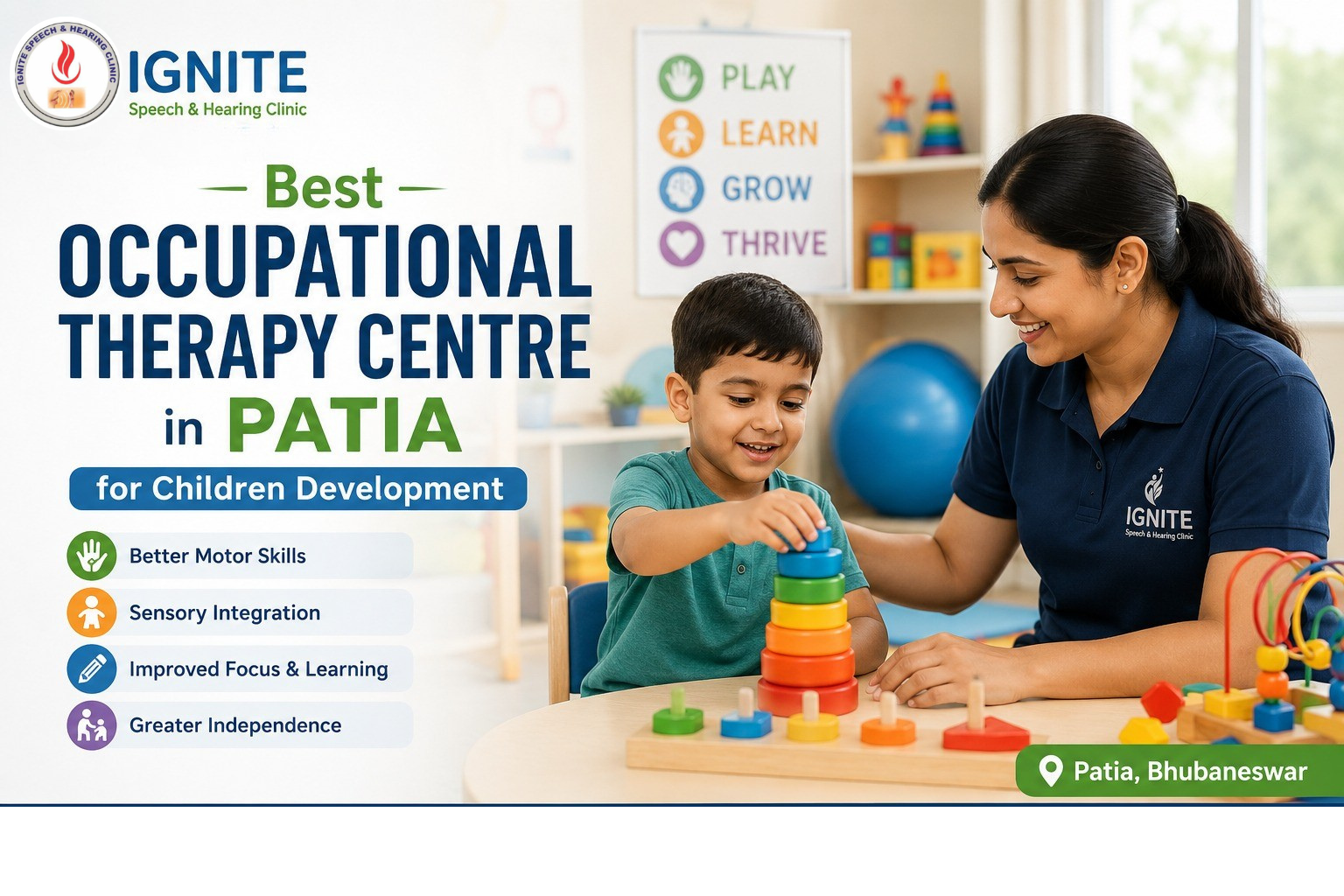
Finding the Best Occupational Therapy centre in Patia for children development can be an important step when a child is having difficulty with movement, sensory processing, attention, self-care, handwriting, play, coordination, or everyday activities. Occupational therapy is not simply about exercises. Pediatric occupational therapy focuses on helping children develop practical skills that allow them to participate more confidently in daily life, at home, at school, and during play. A qualified occupational therapist evaluates the individual child, identifies areas that may be affecting participation, and develops goals suited to the child’s abilities and needs.
For parents in Patia, Sampark Vihar – Lane Number 1, chandrasekharpur, Patia, Bhubaneswar, Odisha 751024, KIIT area, and nearby parts of Bhubaneswar, choosing a child-focused therapy centre can make regular therapy more convenient. Ignite Speech & Hearing Clinic lists occupational therapy among its services and has a Patia branch in Bhubaneswar. Its stated approach includes personalized therapy and multidisciplinary support for children with developmental and communication-related needs.
But what exactly does occupational therapy do for children? Which children may benefit? What should parents look for when choosing a pediatric occupational therapy centre? And how can therapy support a child’s development?
This guide explains these questions in detail.
What Is Pediatric Occupational Therapy?
Pediatric occupational therapy is a specialized area of occupational therapy that helps children participate more independently in everyday activities.
For a child, “occupation” does not mean a job. A child’s occupations include activities such as:
- Playing
- Eating
- Dressing
- Brushing teeth
- Writing
- Drawing
- Using school materials
- Following classroom routines
- Participating in sports
- Interacting with others
- Completing age-appropriate self-care activities
When difficulties with motor skills, sensory processing, coordination, attention, planning, or daily living skills interfere with these activities, an occupational therapist can evaluate the child and develop an individualized intervention plan.
The American Academy of Pediatrics explains that occupational therapy can help children with developmental disabilities who experience challenges involving fine motor skills, sensory processing, self-care, play, and classroom activities. Therapy goals depend on the individual child and are intended to promote greater independence and participation.
This is why pediatric occupational therapy should not be viewed as a one-size-fits-all treatment. Two children with the same diagnosis may have completely different strengths and difficulties.
One child may struggle with handwriting.
Another may find certain sounds or textures overwhelming.
Another may have difficulty sitting at a desk.
Another may need help developing dressing or feeding skills.
The therapy plan should reflect those individual needs.
Why Are Parents Searching for Occupational Therapy in Patia?
Patia has become one of the major residential, educational, and professional areas of Bhubaneswar. Families living around Patia and surrounding neighbourhoods often look for accessible child development and therapy services close to home.
For parents, location matters because pediatric therapy may involve regular sessions and consistent practice. A centre that is reasonably accessible can make it easier to maintain continuity.
However, location should not be the only factor.
When searching for a pediatric occupational therapy centre in Patia, parents should consider:
- The qualifications and experience of the therapist
- Whether the centre performs an appropriate assessment
- Whether therapy goals are individualized
- Whether parents receive guidance for home activities
- Whether progress is monitored
- Whether the centre can coordinate with other professionals when required
- Whether the environment is child-friendly
- Whether the therapist understands the child’s school and daily-life challenges
These factors are often more important than simply choosing a centre because it is nearby.
How Occupational Therapy Supports Child Development
Children develop multiple skills at the same time. Physical development, sensory processing, attention, coordination, communication, learning, and independence can influence one another.
Pediatric occupational therapy can address several functional areas.
1. Fine Motor Skills
Fine motor skills involve the controlled use of the hands and fingers.
Children use fine motor skills when they:
- Hold a pencil
- Write
- Draw
- Use scissors
- Button clothes
- Tie shoelaces
- Pick up small objects
- Build with blocks
- Use a spoon
- Open containers
- Complete craft activities
A child with weak fine motor coordination may find these tasks frustrating or tiring.
Occupational therapists may use age-appropriate activities to develop hand strength, coordination, precision, bilateral hand use, and visual-motor integration.
Activities can be designed around the child’s interests so that therapy feels purposeful rather than repetitive.
2. Gross Motor and Postural Skills
Gross motor skills involve larger body movements.
Children use these skills when they:
- Run
- Jump
- Climb
- Balance
- Catch a ball
- Throw
- Ride a bicycle
- Participate in playground activities
- Maintain posture while sitting
Good postural control can also influence classroom participation.
For example, a child who struggles to maintain a stable sitting position may become tired during writing or classroom activities.
Occupational therapy may incorporate movement-based activities that support body awareness, balance, coordination, strength, and postural control.
3. Sensory Processing
Sensory processing is another important area of pediatric occupational therapy.
Children receive information through sensory systems including:
- Touch
- Movement
- Vision
- Hearing
- Taste
- Smell
- Body position
Some children may appear unusually sensitive to certain sensations.
For example, a child may dislike:
- Certain clothing textures
- Hair washing
- Loud environments
- Crowded places
- Particular food textures
- Unexpected touch
Other children may actively seek movement or sensory input.
Occupational therapists can assess how sensory processing affects functional participation and may use individualized sensory strategies and activities.
Sensory integration approaches are used in pediatric occupational therapy to address sensory processing, regulation, motor coordination, attention, and participation.
It is important to remember that sensory strategies should be individualized rather than copied from another child.
4. Self-Care and Daily Living Skills
One of the most practical goals of pediatric occupational therapy is greater independence.
Children gradually learn activities such as:
- Eating independently
- Dressing
- Wearing shoes
- Brushing teeth
- Washing hands
- Using the toilet
- Organizing school materials
- Packing a school bag
Some children need additional support to learn these skills.
An occupational therapist can break a complicated activity into smaller steps.
For example, instead of simply telling a child to “get dressed,” therapy may break the routine into:
- Choose clothes
- Pick up the shirt
- Identify front and back
- Put arms through sleeves
- Pull the shirt down
- Put on trousers
- Fasten buttons or zippers
Breaking tasks into manageable steps can make learning more achievable.
5. Handwriting and School Skills
School participation is another common reason parents explore pediatric occupational therapy.
A child may have difficulty with:
- Pencil grip
- Writing speed
- Letter formation
- Spacing
- Copying from the board
- Cutting with scissors
- Drawing
- Using classroom tools
- Maintaining attention during written work
Occupational therapy can address underlying skills that support school participation, including fine motor coordination, visual-motor integration, posture, hand strength, and task organization.
The objective is not simply to make a child write more. The broader goal is to help the child participate in school activities more comfortably and effectively.
6. Attention and Task Participation
Some children find it difficult to remain engaged in structured activities.
They may:
- Frequently leave their seat
- Move constantly
- Lose interest quickly
- Require repeated instructions
- Struggle to complete activities
- Become overwhelmed by busy environments
Attention difficulties can have many possible causes, so parents should avoid assuming a diagnosis based only on behaviour.
An occupational therapist can look at the child’s functional performance and identify factors that may affect participation.
For some children, structured activities, movement breaks, environmental adjustments, visual routines, and task modifications may support participation.
Children with ADHD may also receive occupational therapy as part of a broader individualized support plan. Pediatric occupational therapy can address functional participation, self-regulation, motor skills, and daily routines.
7. Motor Planning and Coordination
Motor planning refers to the ability to think about, organize, and carry out physical movements.
A child with motor planning difficulties may find it challenging to:
- Learn a new movement
- Follow multi-step physical instructions
- Coordinate both hands
- Copy movements
- Participate in playground games
- Complete unfamiliar activities
Occupational therapy can use purposeful play and structured movement activities to support coordination and motor planning.
The activities should be appropriate to the child’s developmental level and goals.
Occupational Therapy for Children with Developmental Delays
Developmental delay can affect one or more areas of development.
A child may experience delays in:
- Gross motor development
- Fine motor development
- Adaptive skills
- Communication
- Social participation
- Learning
- Self-care
Occupational therapy can be part of an early intervention or multidisciplinary support program.
The exact therapy approach depends on the child’s assessment.
For example, one child may need support with sitting and hand use, while another may need support with sensory regulation and self-care.
Occupational therapy is therefore most useful when the intervention is connected to real-life functional goals.
Occupational Therapy and Autism
Autistic children can have a wide range of strengths and support needs.
Some children may experience difficulties involving:
- Sensory processing
- Motor coordination
- Play
- Self-care
- Feeding
- Attention
- Flexibility
- Participation in daily routines
Occupational therapy may address functional skills and participation based on the child’s individual needs.
For example, therapy goals might include:
- Improving tolerance for specific activities
- Developing dressing skills
- Supporting handwriting
- Increasing independence with feeding
- Building play skills
- Improving fine motor coordination
- Supporting participation in school routines
The aim should not be to make every child behave identically. Instead, therapy should focus on helping the child participate, communicate needs, learn skills, and become more independent.
Occupational Therapy for Children with ADHD
Children with ADHD may experience difficulties with:
- Attention
- Impulse control
- Organization
- Task completion
- Movement regulation
- Classroom participation
- Daily routines
Occupational therapy may help identify practical strategies that support participation in home and school environments.
A therapist may work on:
- Structured routines
- Organization
- Motor activities
- Task sequencing
- Environmental modifications
- Self-regulation strategies
- Functional school skills
OT is often one component of a broader care plan rather than a standalone solution for every child.
Feeding and Oral-Motor Support
Some pediatric occupational therapy programs also address feeding-related functional difficulties.
Children may experience:
- Extreme food selectivity
- Difficulty with textures
- Difficulty using utensils
- Problems sitting for meals
- Oral-motor challenges
Feeding concerns should be assessed carefully because there can be many contributing factors.
Where appropriate, an occupational therapist may work on functional feeding skills, sensory tolerance, oral-motor coordination, and mealtime routines.
If there are concerns about swallowing, nutrition, growth, or medical problems, appropriate medical and feeding professionals should also be involved.
How Does an Occupational Therapy Assessment Work?
Before beginning a structured therapy program, a qualified occupational therapist should understand the child’s strengths, challenges, routines, and goals.
An assessment may consider:
Motor Skills
Fine motor and gross motor abilities.
Sensory Processing
How the child responds to different types of sensory information.
Visual-Motor Skills
How the eyes and hands work together.
Self-Care
Eating, dressing, hygiene, and other daily tasks.
School Participation
Writing, classroom routines, attention, and use of school materials.
Play
Age-appropriate play and participation.
Functional Independence
How independently the child completes everyday activities.
A pediatric occupational therapy evaluation may include observation, caregiver discussion, standardized or structured assessment tools when appropriate, and functional analysis.
The result should be an individualized understanding of what the child can do and where support may be useful.
Why Individualized Therapy Matters
There is no single occupational therapy exercise that works equally well for every child.
Consider two children.
Child A has good motor skills but becomes overwhelmed by certain sensory experiences.
Child B enjoys sensory activities but has significant difficulty with handwriting and fine motor control.
Their therapy programs should be different.
Individualized therapy allows the therapist to focus on meaningful goals rather than following a generic exercise list.
This is especially important in pediatric therapy because children’s developmental profiles can change as they learn new skills.
What Should Parents Look for in the Best Occupational Therapy Centre in Patia?
If you are comparing occupational therapy centres in Patia, consider the following checklist.
Qualified Professionals
Ask about the therapist’s professional education, experience, and pediatric specialization.
Child-Friendly Environment
Children often respond better to therapy when the environment feels safe, welcoming, and engaging.
Individualized Goals
Ask whether your child’s therapy plan is based on an assessment.
Parent Involvement
Parents should understand what skills are being targeted and how they can support practice at home.
Progress Monitoring
A good therapy program should monitor functional progress rather than relying only on attendance.
Multidisciplinary Support
Some children benefit from coordinated support involving occupational therapy, speech therapy, special education, behavioral support, physiotherapy, or medical professionals.
Convenient Location
For families around Patia, having a centre nearby can make regular attendance easier.
Communication
Parents should feel comfortable asking questions and discussing concerns.
Why Early Support Can Be Valuable
Parents sometimes wait because they hope a developmental difficulty will disappear naturally.
Every child develops at their own pace, and small differences do not automatically mean that a child has a developmental disorder.
However, persistent difficulties that interfere with everyday activities deserve attention.
Early assessment can help parents understand whether there is an actual functional concern and what type of support may be appropriate.
Early intervention does not mean rushing to label a child.
It means understanding the child’s needs and providing appropriate support when it can help.
For children with developmental challenges, occupational therapy can support independence, motor development, sensory processing, daily routines, and participation.
Occupational Therapy Should Be Fun for Children
Children learn through play.
Therefore, pediatric occupational therapy often incorporates activities that are engaging and purposeful.
A session might include:
- Puzzles
- Drawing
- Building blocks
- Ball activities
- Climbing
- Balance activities
- Fine motor games
- Cutting and craft activities
- Sensory play
- Dressing practice
- Feeding-related activities
The activity should have a therapeutic purpose.
For example, a simple game involving picking up small objects can target hand coordination.
A climbing activity can address movement, balance, and motor planning.
A dressing activity can support independence.
This makes therapy meaningful rather than simply repetitive.
The Role of Parents in Occupational Therapy
Therapy does not end when the session finishes.
Parents play an important role in helping children practice skills in natural environments.
A therapist may recommend simple activities that can be incorporated into everyday routines.
For example:
Instead of creating a separate 30-minute handwriting practice session, parents may encourage the child to draw, colour, trace, or write a short shopping list.
Instead of treating dressing as a rushed morning task, parents may allow additional time for the child to practice individual steps.
Instead of forcing a child into an uncomfortable sensory experience, parents can follow appropriate therapist guidance and gradually work toward functional participation.
Consistency is often more useful than occasional intensive practice.
Occupational Therapy and Other Child Development Services
Children sometimes need more than one type of support.
Occupational therapy may work alongside:
- Speech therapy
- Audiology
- Special education
- Behavioral therapy
- Physiotherapy
- Developmental pediatrics
- Psychology
- Feeding support
For example, a child with communication and sensory challenges may benefit from both speech therapy and occupational therapy.
A child with developmental delay may require occupational therapy alongside physiotherapy or special education.
A multidisciplinary approach can help professionals look at the child’s development from different perspectives.
Ignite Speech & Hearing Clinic describes a multidisciplinary approach involving audiologists, speech-language professionals, and occupational therapists, and lists speech therapy, occupational therapy, special education, behavioral therapy, and cognitive therapy among its services.
Why Choose a Local Pediatric Occupational Therapy Centre in Patia?
For families in Patia, choosing a nearby therapy centre can offer practical advantages.
Regular therapy may be easier to manage when travel time is reasonable.
It can also make it easier to:
- Maintain consistent appointments
- Communicate with therapists
- Attend parent consultations
- Monitor progress
- Coordinate multiple therapy services
- Integrate therapy into the child’s weekly routine
Ignite Speech & Hearing Clinic currently lists a Bhubaneswar Patia location at Sampark Vihar – Lane Number 1, chandrasekharpur, Patia, Bhubaneswar, Odisha 751024 and lists occupational therapy among its services.
Parents should confirm current appointment availability, therapist availability, and service details directly with the centre before visiting.
What Results Can Parents Expect from Occupational Therapy?
Every child is different.
Occupational therapy does not guarantee a specific result or timeline.
Progress depends on factors such as:
- Child’s age
- Individual developmental profile
- Current abilities
- Therapy goals
- Frequency of sessions
- Home practice
- School environment
- Other health or developmental factors
- Family participation
Progress may appear as small functional changes.
For example:
A child may hold a pencil more comfortably.
A child may put on a shirt with less assistance.
A child may tolerate a previously difficult activity.
A child may complete a classroom task for longer.
A child may become more independent during meals.
These practical changes can be meaningful because they improve everyday participation.
When Should Parents Consider an Occupational Therapy Assessment?
Consider discussing an assessment with a qualified professional if your child consistently has difficulty with everyday activities such as:
- Holding or using a pencil
- Using scissors
- Dressing
- Eating independently
- Using utensils
- Maintaining posture
- Participating in play
- Coordinating movements
- Managing certain sensory experiences
- Completing age-appropriate self-care tasks
- Participating in school activities
- Following multi-step motor tasks
Parents should not use a checklist to diagnose their child.
Instead, persistent concerns can be discussed with a pediatrician, developmental professional, or qualified therapist.
Frequently Asked Questions About Pediatric Occupational Therapy in Patia
1. What is occupational therapy for children?
Pediatric occupational therapy helps children develop skills required for everyday activities such as playing, learning, dressing, eating, writing, and self-care. Therapy is individualized according to the child’s needs and functional goals.
2. Which children can benefit from occupational therapy?
Children with developmental delays, sensory processing challenges, motor coordination difficulties, autism, ADHD, learning-related functional difficulties, and challenges with daily living or school activities may benefit from occupational therapy. The appropriate therapy plan depends on individual assessment.
3. Can occupational therapy help with handwriting?
Yes. Occupational therapists may work on fine motor coordination, hand strength, visual-motor integration, posture, pencil control, and other skills related to handwriting and school participation.
4. Does occupational therapy help children with autism?
Occupational therapy can support autistic children with functional areas such as sensory processing, self-care, play, motor skills, and participation in daily routines. Goals should be individualized according to the child’s needs.
5. Is occupational therapy useful for developmental delay?
It can be. Occupational therapy may support motor, sensory, adaptive, self-care, and functional participation skills in children with developmental delays. An assessment helps determine whether OT is appropriate and what goals should be targeted.
6. How often does a child need occupational therapy?
There is no universal schedule. Frequency depends on the child’s needs, goals, age, functional difficulties, and therapist recommendations.
7. Should parents practice therapy activities at home?
When appropriate, therapists may recommend simple home activities. Following professional guidance can help children practice skills in natural daily routines.
8. How do I choose an occupational therapy centre in Patia?
Look for qualified pediatric therapists, individualized assessment, measurable goals, parent communication, progress monitoring, child-friendly facilities, and convenient access.
Finding the Right Occupational Therapy Support in Patia
Searching online for the Best Occupational Therapy centre in Patia for children development is a useful first step, but parents should go beyond rankings and advertisements.
The right centre should focus on the individual child.
Ask:
“Does the therapist understand my child’s specific difficulties?”
“Are the goals connected to everyday life?”
“Will I receive guidance about what I can do at home?”
“How will progress be measured?”
“Can the centre coordinate with other professionals if needed?”
These questions can help families make a more informed decision.
Occupational Therapy at Ignite Speech & Hearing Clinic
Ignite Speech & Hearing Clinic provides developmental and therapy services for children and adults, including occupational therapy. The clinic states that its approach involves personalized, evidence-based care and multidisciplinary collaboration. Its listed services include occupational therapy, speech therapy, special education, behavioral therapy, autism treatment, and cognitive therapy.
The clinic also lists a Patia branch in Bhubaneswar, making it an option for families searching for pediatric therapy services in the Patia area.
If your child is experiencing challenges with fine motor skills, sensory processing, self-care, handwriting, coordination, or participation in everyday activities, an occupational therapy assessment can help determine what type of support may be appropriate.
Final Thoughts
Child development is not a race.
Every child has individual strengths, preferences, abilities, and challenges. When a child finds certain everyday activities difficult, the first step is understanding why.
Pediatric occupational therapy can help children develop practical skills for playing, learning, communicating, participating, and becoming more independent.
From fine motor skills and handwriting to sensory processing, self-care, coordination, and daily routines, occupational therapy focuses on skills that matter in real life.
For families searching for the Best Occupational Therapy centre in Patia for children development, it is important to choose a centre that combines qualified professionals, individualized assessment, child-friendly therapy, family involvement, and ongoing progress monitoring.
Ignite Speech & Hearing Clinic’s Patia branch offers occupational therapy as part of its broader developmental and therapy services. Parents can contact the centre to discuss their child’s concerns and determine whether an occupational therapy assessment is appropriate.
The goal of therapy is not simply to complete exercises inside a clinic.
The real goal is to help children participate more confidently in everyday life.
A child learning to hold a pencil.
A child learning to button a shirt.
A child participating more comfortably in play.
A child becoming more independent during meals.
A child managing school activities with greater confidence.
These everyday achievements are what make pediatric occupational therapy meaningful.
If you have concerns about your child’s development, consider speaking with a qualified pediatric professional rather than waiting and worrying alone. An appropriate assessment can help you understand your child’s strengths, identify areas where support may be useful, and create a practical plan for the next step.
